Mowgli's Song
The Jungle BookMowgli's Song, also called The Song of Mowgli, is Mowgli's first-person song of memory, grievance, triumph, and divided belonging. Its decisive image is Mowgli dancing at Council Rock on Shere Khan's hide: the song makes his actions audible to the jungle and converts a history of rejection into proof that he remains a figure within it.
Occasion and Form
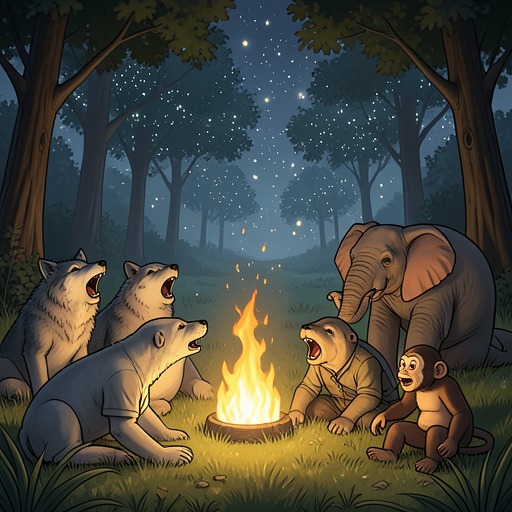
Mowgli's Song is presented after the narrative of Mowgli's life in the jungle and is specifically identified as the song he sang at Council Rock when he danced on Shere Khan's hide. It therefore belongs to a moment of public performance rather than private reflection. Mowgli does not merely remember what happened; he sings his own account before the wolves, asking the jungle to listen to the things he has done.
The song uses direct self-announcement rather than an outside narrator's explanation. It begins, "The Song of Mowgli—I, Mowgli, am singing. Let the jungle listen to the things I have done." That opening establishes both speaker and audience. Mowgli's name is repeated as a claim of identity, while the jungle is treated as a community capable of hearing, judging, and remembering.
Exile and Divided Belonging
The song gathers together two expulsions. Mowgli recalls that the Man-Pack cast him out even though he had done them no harm, and he asks why they were afraid of him. He then records the wolf pack's rejection as well, saying that the Wolf Pack cast him out and that the jungle was shut to him. The parallel structure makes neither society an uncomplicated home: human beings fear him, while the wolves deny him their collective place.
Yet the song does not end in pure homelessness. Mowgli says that his heart is very light because he has come back to the jungle. His return carries an emotional contradiction that the song states openly: "These two things fight together in me as the snakes fight in the spring. The water comes out of my eyes; yet I laugh while it falls." Tears register the wounds of expulsion, but laughter registers survival and restored movement. The image does not resolve the conflict between grief and happiness; it preserves both as active forces within him.
Shere Khan and the Proof of Action
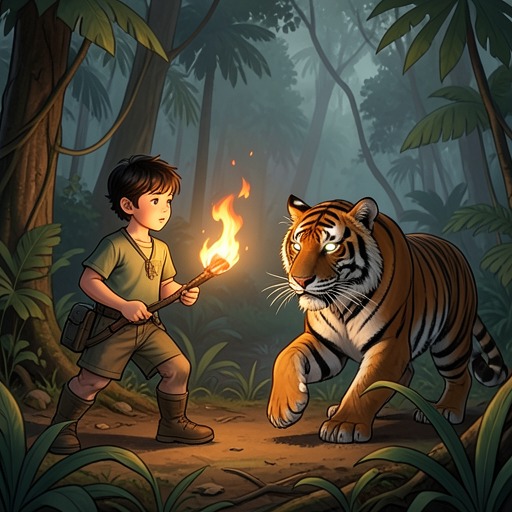
The song's central achievement is the killing of Shere Khan. Mowgli recalls that Shere Khan had threatened to kill him, then places the tiger's hide beneath his feet. The hide is not a decorative trophy in the song's structure. It is physical evidence that answers the threat and gives public weight to Mowgli's voice.
Mowgli describes the result through the striking declaration, "I am two Mowglis, but the hide of Shere Khan is under my feet." The line joins divided identity to victorious action. He is still split between the worlds that have rejected him, but the tiger's hide gives that division a point of strength: whatever uncertainty remains within him, the jungle can see what he has done. He then insists that all the jungle knows he has killed Shere Khan and calls upon the wolves to look well.
Audience, Recognition, and Narrative Role
The repeated summons to the wolves turns the song into an appeal for recognition. Mowgli does not ask the pack to forget its rejection; instead, he confronts it with the visible consequence of his deeds. The song's audience is therefore both communal and judicial. The wolves are witnesses before whom Mowgli presents his identity, his suffering, and his victory.
Its language also echoes the larger system of jungle teaching that shaped Mowgli. During the period when Baloo taught him the Law of the Jungle, Mowgli learned not only the Hunting Verse but also the Wood and Water Laws, the Strangers' Hunting Call, and the words required for respectful dealings with bees, bats, and water-snakes. Mowgli's Song reverses the direction of that earlier instruction: the pupil who once recited lessons now speaks publicly in his own name, using song to interpret the consequences of what he has learned.
The song is consequently both recollection and self-creation. Mowgli's past is not arranged as a neutral chronology; it is shaped into a pattern of threats, expulsions, return, and proof. Its final emphasis on the hide under his feet gives the performance a physical ending: the divided figure stands above the sign of his greatest enemy, while the wolves are commanded to see him clearly. In that sense, Mowgli's Song preserves the pain of exclusion but refuses to let exclusion have the last word.